
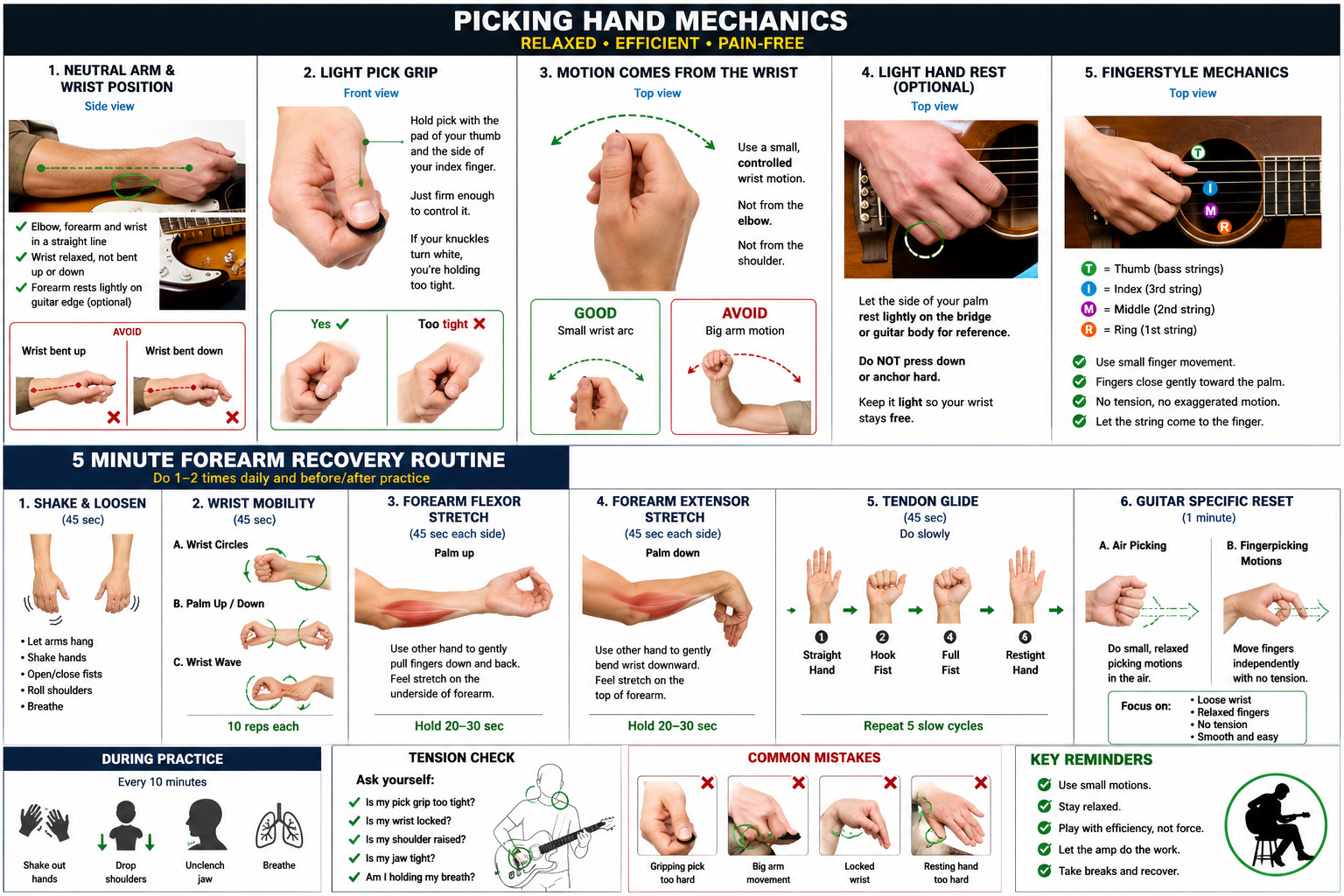
Picking Hand Mechanics
When most guitarists get stuck, they assume the problem is in the fretting hand.
But more often than not, the real issue is happening on the picking side.
Your picking hand controls timing, tone, dynamics, and consistency. If it’s inefficient or tense, everything else feels harder than it should.
Let’s break down what actually matters.
1. Start With Relaxation
If your picking hand is tight, your playing will feel limited.
Look at your hand while you play:
- Are your fingers clenched?
- Is your wrist locked?
- Are you gripping the pick too hard?
You don’t need force to get good tone. You need control.
A relaxed hand moves faster, reacts better, and stays consistent over longer sessions.
2. Pick Grip: Firm, Not Rigid
Hold the pick between your thumb and index finger.
That’s it.
Not three fingers. Not a full fist.
Think of it like holding a pen:
- Secure enough so it doesn’t fall
- Loose enough to stay flexible
If the pick can’t move at all, your hand will compensate with tension.
3. Motion Comes From the Right Place
Most efficient picking comes from small, controlled movements.
Focus on:
- Wrist motion over large arm movement
- Short strokes instead of wide swings
- Staying close to the strings
Big movements feel powerful, but they slow you down and make accuracy harder.
4. Stay Close to the Strings
The further your pick travels, the more work your hand has to do.
Try this:
- Play a simple exercise
- Watch how far your pick moves past the string
Now reduce that distance by half.
You’ll notice:
- More control
- Better timing
- Less fatigue
5. Angle Changes Everything
A flat pick hitting the string head-on creates more resistance.
Slightly angle your pick:
- It should glide across the string, not fight it
This small adjustment can instantly make your playing feel smoother.
6. Consistency Over Speed
Speed is not the goal.
Consistency is.
If your picking is uneven, speeding up will only exaggerate the problem.
Instead:
- Slow it down
- Make every note sound even
- Then gradually increase speed
Clean first. Fast later.
7. Watch Your Anchor Points
Some players rest part of their hand on the bridge or strings.
That’s fine.
Just make sure:
- You’re not locking your hand in place
- You can still move freely across strings
Your anchor should support control, not restrict movement.
Final Thought
Your picking hand is the engine of your playing.
If it’s tense or inefficient, everything feels harder than it should.
If it’s relaxed and controlled, everything starts to click.
Take a few minutes to observe your picking hand today. Small adjustments here can completely change how your playing feels.
Disclaimer: Practice responsibly and within your physical limits. B.E. Music Lab is not responsible for injuries, strain, discomfort, or other physical or emotional issues resulting from the application of techniques, exercises, or recommendations discussed in this content.
Leave a Reply