Category: blog posts

  • “Can You Just Look It Up?” — Here’s Why I Don’t

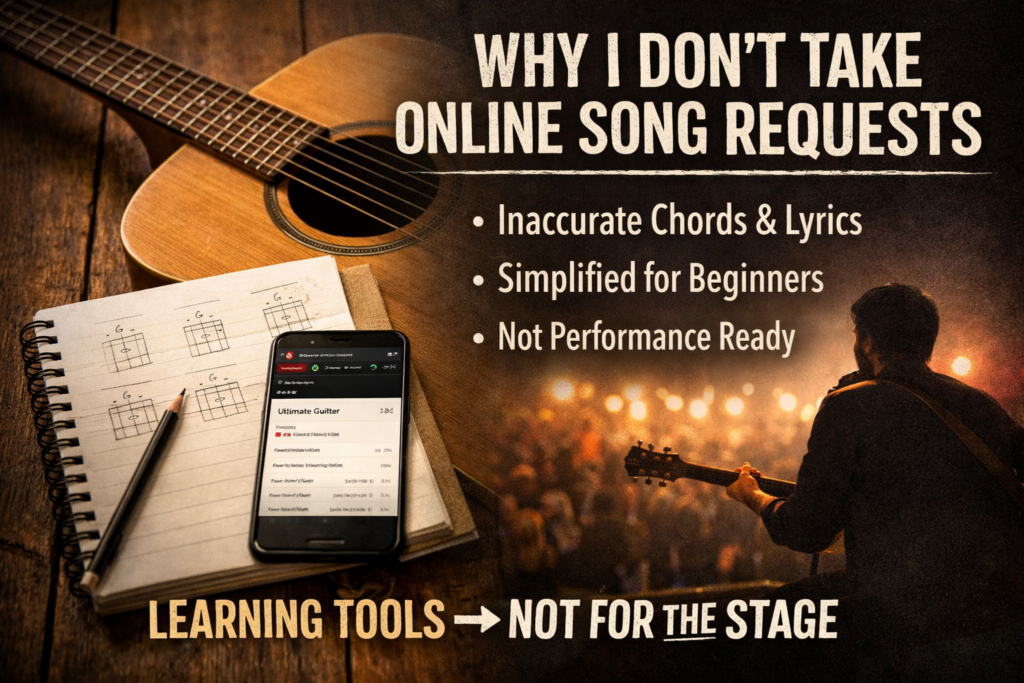
    Why I Don’t Take “Look-It-Up” Song Requests

    In almost every live setting or lesson environment, someone will ask:

    “Can you play this song?”

    “Can you just look it up?”

    It’s a fair question—and it comes from a good place. People are excited about music and want to hear something they love.

    But here’s the honest answer:

    I don’t take requests for songs I don’t already know, and I don’t look them up on the spot.

    Not because I’m unwilling—but because I care about doing it right.

    The Problem With “Just Looking It Up”

    Most people are referring to sites like Ultimate Guitar.

    And to be clear—Ultimate Guitar is a great resource… when it’s used the right way.

    But it was never designed for what people think it is.

    What Ultimate Guitar 

    Is

     Good For

    Ultimate Guitar is excellent for:

    • Getting beginners started
    • Learning basic chord shapes
    • Getting a rough outline of a song
    • Building confidence early on

    It helps take you from:

    “I’ve never played before”

    to

    “I can strum something that resembles a song”

    And that’s valuable.

    What It’s 

    Not

     Designed For

    Here’s where things get misunderstood.

    Those chord charts are often:

    • Simplified to make songs easier to play
    • Transposed to beginner-friendly keys
    • Missing harmonic detail
    • Occasionally incorrect—both chords and lyrics

    In some cases, lyrics and structure are altered for legal reasons or user-submitted inconsistencies.

    So what you end up with is not the song—it’s an approximation of the song.

    Why That Matters in a Live Setting

    When I play music publicly, whether it’s a performance or teaching:

    I’m not trying to approximate the music.

    I’m trying to:

    • Respect the original composition
    • Deliver something musically accurate
    • Create a meaningful listening experience

    Pulling up a simplified, potentially incorrect version of a song and playing it on the spot doesn’t meet that standard.

    And honestly—it doesn’t serve the listener, either.

    There’s a Difference Between Learning and Performing

    This is the key distinction:

    • Learning tool → Ultimate Guitar is great
    • Performance tool → It falls short

    If I’m learning a song, I’ll:

    • Listen deeply
    • Analyze the harmony
    • Work out fingerings that make musical sense
    • Internalize the phrasing and feel

    That takes time—and that’s what allows the music to sound right.

    Why I Choose Not to “Fake It”

    Could I fake my way through a song using a quick chart?

    Sure.

    But that’s not what I stand for as a musician or teacher.

    With over 40 years of experience, my goal is not to:

    “Get through the song”

    It’s to:

    “Make it sound like music”

    And there’s a big difference.

    What I Do Offer Instead

    If someone requests a song I don’t know, I’ll often say:

    “I’d be happy to learn that properly.”

    Because that’s the right way to approach it.

    And for students, this becomes an important lesson:

    Music isn’t about shortcuts—it’s about understanding.

    The Bigger Picture

    Tools like Ultimate Guitar are incredibly helpful—but only when we understand their role.

    They are:

    • A starting point
    • A guide
    • A stepping stone

    They are not:

    • A definitive source
    • A substitute for listening
    • A performance-ready solution

    Final Thought

    If you want to truly grow as a musician, the goal isn’t just to play songs…

    It’s to understand them well enough that you don’t need to look them up.

    That’s where real freedom begins.

  • 5 minute practice

    Practice routines work

    If you’ve ever picked up your guitar, played for 20 minutes, and felt like you got nowhere—this is for you.

    Most beginners don’t need more time.
    They need a simple, repeatable system.

    This 5-minute routine works because it focuses on just enough practice to build real skill—without burnout.


    The 5-Minute Practice System

    You’ll rotate through 4 small steps:

    1. One chord
    2. One strumming pattern
    3. One chord change
    4. One musical moment

    That’s it.


    1. One Chord (1 minute)

    Pick one chord only (start with G, C, or D).

    Your goal is not speed.
    Your goal is clean sound.

    What to focus on:

    • Every string rings clearly
    • No buzzing
    • Fingers are close to the frets (not on top of them)
    • Relax your hand—don’t squeeze

    Pro tip:
    Play each string one at a time. Fix problems immediately.


    2. One Strumming Pattern (1 minute)

    Keep it simple:

    Down – Down – Down – Down

    Don’t worry about being perfect.
    Focus on steady motion.

    Key idea:

    Your hand should keep moving—even if you miss a string.

    That’s how rhythm starts to feel natural.


    3. One Chord Change (2 minutes)

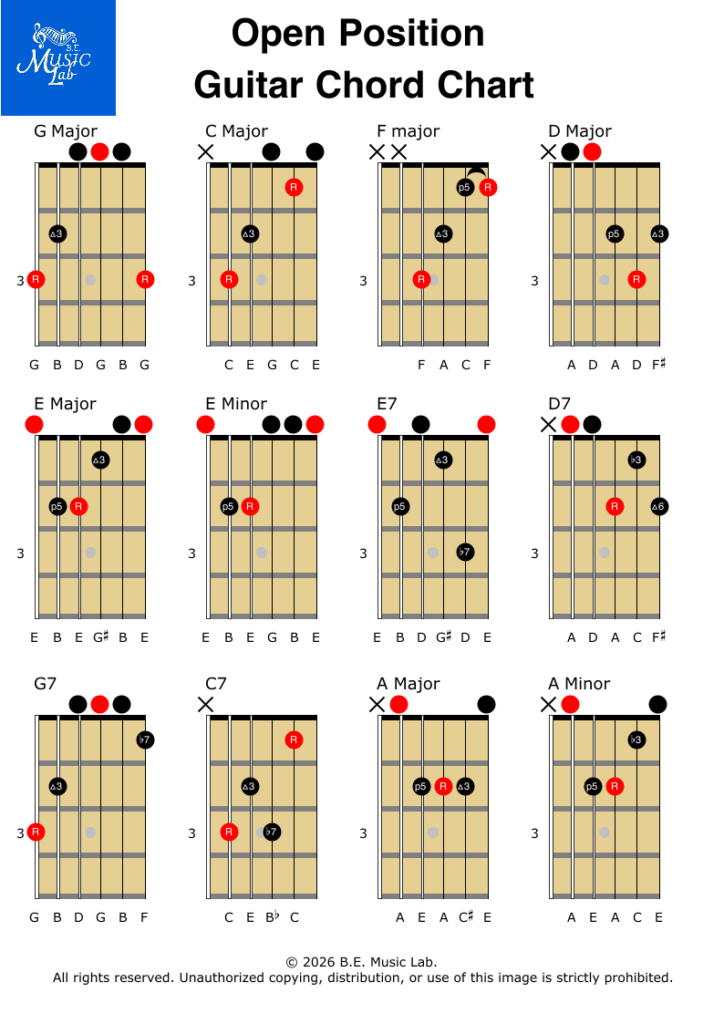
    Now pick just two chords from the chart above:

    • G → C
      or
    • C → D

    The method:

    • Play chord 1
    • Pause
    • Slowly switch to chord 2
    • Repeat

    The trick (this is the breakthrough):

    Move slowly enough that you never fail

    Speed comes later. Accuracy comes first.

    Bonus tip:

    Look for anchor fingers (fingers that stay the same between chords).
    They make everything easier.


    4. One Musical Moment (1 minute)

    Image

    This is the part most people skip—and it’s the most important.

    Take what you just practiced and make it musical.

    • Strum your two chords like a song
    • Repeat a simple pattern
    • Let it feel like music

    No stopping. No correcting. Just play.


    Why This Works

    • It removes overwhelm
    • It builds real skills (not random practice)
    • It creates consistency
    • It makes practice enjoyable again

    Most importantly:
    It gives you a win every day


    Your Daily Goal

    Don’t practice longer.
    Practice tomorrow.

    That’s how progress actually happens.


    Want Help Staying Consistent?

    If you want guidance, structure, and someone to walk you through this step-by-step, I offer one-on-one guitar lessons (online & in-person).

    We focus on:

    • Simple systems like this
    • Real songs (not boring exercises)
    • Making guitar feel natural and fun

    Happy Practicing.

    Got questions?
    Feel free to reach out.

    Contact Form Demo

  • 10 easy campfire songs for beginner guitarist

    Lorem Ipsum has been the industry’s standard dummy text ever since the 1500s.

    1. Knockin’ on Heaven’s Door – Bob Dylan
      Chords: G – D – Am
      Slow, repetitive, almost impossible to mess up.
    2. Horse with No Name – America
      Chords: Em – D6add9/F# (basically 2 shapes)
      This is the cheat code of campfire songs.
    3. Wonderwall – Oasis
      Chords: Em7 – G – Dsus4 – A7sus4
      Crowd will sing whether you like it or not.
    4. Let It Be – The Beatles
      Chords: C – G – Am – F
      Great for teaching I–V–vi–IV without saying it out loud.
    5. Stand By Me – Ben E. King
      Chords: G – Em – C – D
      Smooth groove, very loopable.
    6. Sweet Home Alabama – Lynyrd Skynyrd
      Chords: D – C – G
      Three chords, lots of confidence.
    7. Brown Eyed Girl – Van Morrison
      Chords: G – C – G – D
      Feels harder than it is—great payoff.
    8. I’m Yours – Jason Mraz
      Chords: G – D – Em – C
      Same progression as half of modern music.
    9. Take Me Home, Country Roads – John Denver
      Chords: G – Em – D – C
      Built-in singalong moment.
    10. Riptide – Vance Joy
      Chords: Am – G – C
      Easy strum, very recognizable.

    Quick tip (this matters more than the song):

    If you can play G, C, D, Em, and Am, you can fake your way through like 80% of campfire songs.
    It’s less about perfection and more about keeping time and not stopping.

    Happy Practicing!

    Got questions?
    Feel free to reach out.

    Contact Form Demo